I caught this scene Friday night with Minnie up at Mormon Lake. Got lucky with the circumstances of heavy clouds stalled to the west.
I mentioned to Minnie in the early evening, “It might be possible to see the Aurora Borealis tonight.” Friday night’s activities were a choice between finding some chicken wings or the same old, same old. Minnie, being the adventurer she is, chose to head north with the camera gear.
It’s all kind of a blur from there as we fight traffic up the I-17. The construction project is taking the night off, but the need for extra lanes heading to Flagstaff is apparent. Minnie and I reminisce about the good ole’ days before the population influx in Arizona. She’s a native of Phoenix and I have lived here long enough to claim this as my home state now.
Red Aurora Borealis and Milky Way in Arizona
Lost in the Smoke
We find the turn-off for Lake Mary and see some LED highway warnings, “Caution! Prescribed Burn Ahead. Heavy Smoke”. The scene suddenly goes from a dark two-lane blacktop cutting through a tall pine forest to thick white smoke.
We slow down and pass an elk standing on the side of the road that suddenly appears from the white smoke. The large beast tries to orient itself after being smoked out from his grassy bed. Wandering down to the highway as an alien in a Toyota with bright lights blinds him. If I rolled down the window I could have pet the majestic elk cow as we drove past.
I provide the navigation to the best view of the Milky Way core. It’s almost perfectly South East in the night sky gently arcing north. Our galaxy is a barred spiral galaxy like the image below taken by the Hubble Space Telescope. I would show a picture of our galaxy, but the Hubble didn’t have a selfie stick long enough, so we’ll have to wait for it to exit our galaxy. Who knows if it will still be working by then.
We continue through the smoke. Sometimes it looks like it’s about to clear then a swath of stale smokey air clouds the path again. The conversation intensifies as we lose sense of direction. I finally get a better view of the map and see a scenic outlook. The smoke and clouds clear as we approach our destination and we have our view of the Milky Way in the South East and the Aurora Borealis to the North.
Aurora Borealis
We set up the camera with a Nikon 35mm lens and take some test shots to get the settings right. I show Minnie how to take a panoramic with multiple panning shots, then lean back and watch her go to town.
We got lucky. The smoke and heavy clouds stall to the west of us encroaching on the Aurora. To the naked eye, the Milky Way and Aurora Borealis are just faint white wispy clouds in the night sky. Through the lens are some of the colors our eyes can’t see. What a wonderful night! A couple lovers enjoying a shared passion as the sun explodes, creating geomagnetic storms that could wipe out all of life as we know it. We are protected by an atmosphere that shields us as the energy is transformed into vibrant pink and red light waves of love.
I decided to knock a couple things off my bucket list this week. For a guy who has lived in Arizona over half his life now, it was time to visit the Grand Canyon. For some reason it’s one of those places I kind of expected to visit with someone special, but no point in waiting.
I was looking into the trip a couple weeks in advance to coincide with dark skies for some Milky Way shots. It was tough making up my mind if I should go to the North or South Rim. I had picked some places that would work for a really long day into the night. A few days before I was thinking the South Rim would be best. There are a few areas to peel off east for camping and great foregrounds for a night shot of the Milky Way.
The day of I just woke up and Googled Grand Canyon. It came up with the Skywalk. The Mitsubishi Outlander was loaded up for a night of photography and I headed out. And once again proper planning was not happening. I just got out of Phoenix when Google Maps directed me to Arizona State Highway 74. I was thinking, “Hmmm that doesn’t seem right…” Then continued anyway thinking it wouldn’t be that big of deal. I needed to kill time until the afternoon casted shadows along the canyon anyway. When I arrived I realized this was more suited for tourism.
Despite what it looks like zoomed out on a digital map the Grand Canyon is pretty large. I ended up turning around to make it to the South Rim before dark. Honestly this is how I like operating anyway. It’s exploration and scouting for future trips. One day I will give it a go again.
Please check with the Navajo Nation Parks for guided tours on sovereign land.
Desert View Watch Tower
So after another 200 something miles I ended up at the Desert View Watch Tower. Along the way I noticed the Slate Fire billowing smoke. The smoke was dissipating over the Navajo Nation along Route 64. It created some interesting filtered light as the afternoon sun shone through. Eventually I was on the other side of the smoke at the Grand Canyon Desert View Watch Tower entrance.
Image taken from Desert View Watch Tower viewing area. Smoke from the Slate fire can be seen in the upper left of the photo.
The crowd was light since it was a week day, but still required some patience to get in position for shots. I have to admit my issues with vertigo kicked in. What was weird though is when looking through the view finder of the camera the feelings went away. Only to come back with a vengeance soon as I pulled the camera away. I was sure I was going to lose balance and bounce off canyon walls to a brutal demise.
View of the desert watch tower over the Grand Canyon with cloudy smoke filled skies
View southwest of the watch tower with the afternoon sun setting
I tested my gut a few more times along the southwest side of the watch tower with no guardrail. I had to squat to keep from feeling wobbly, but still managed to get this photo above.
A crow happened to fly by as I was setting up for a stacked image of the Grand Canyon and Colorado River
Purple Majesty – Composite image with colorization and layer blending
As I was walking back to the parking lot I came across some Apache Plume. And a Tarantula Hawk… Not sure what it is, but seems like I have been seeing a lot of these insects lately. This time I was in a better position to get a great shot of the feather like flowers with the dark shades of the the ominous insect.
Apache Plume close-up
A Tarantula Hawk in Apache Plume with curled antennae
Desert View Drive
It’s funny how quickly the sun sets when you have things to get done in daylight. I continued along Desert View Drive to see more spectacular views of this amazing chasm cutting through the earth. The next stop was Navajo Point, which was a little less crowded.
View form Navajo Point of the Grand Canyon
View of sun over a hazy Grand Canyon from Lipan Point
I continued on to Lipan Point where the wind and sun created a view DaVinci would love with an endless atmospheric perspective. Looking at my map, I knew I didn’t have much time to spare getting the best pictures. I was pleasantly surprised with how well these images stacked for a high definition resolution (HDR) without using a tripod.
Western view of the Grand Canyon from Lipan point.
The sunsets behind the clouds and trees from an unnamed scenic viewpoint
A juniper flower catching the last of the sunlight.
Duck on a Rock scenic Viewpoint of the Grand Canyon
The view of the Duck on a Rock was a quick stop. I noticed along the way people were using drones. The kid flying one here mentioned if it went sideways he would lose it. It makes me wonder how many drones and other objects rest at the bottom of these scenic outlooks of the Grand Canyon.
Unknown viewpoint of the Grand Canyon during the Blue hour
The last picture I took I think gives a better idea of the scope of the Grand Canyon. First of all Evil Knievel ain’t making that with out some wings. This was created by water over millions of years. Millions of years! It makes you think about how brief our lives are in the grand scheme of it all. Also it made me think about how nice it would be to sleep in my bed and I drove back to Phoenix for the night.
Meteor Crater
The next day I woke up and started working on the Grand Canyon images. I was a little miffed about the Slate Fire and clouds. But both were out of my control. I kept taking a look at the evolving weather along Baja, Mexico to see if there was a chance for clear skies that night. I figured it was worth a try and headed North again.
Panoramic view of Meteor Crater
Apollo 11 test capsule
As a kid it was a dream of mine to become an astronaut, when I saw the Apollo 11 test capsule was there I had to go. Meteor Crater is a private facility that was also used to train astronauts for the moon landing. To me it’s an engineering feat that we did so much with so little at that time in history. Notice how this looks like a diving bell, which is a 400 year old invention. The difference between water and the layers of the atmosphere is density along with other gases. So basically this is a really sturdy balloon.
It’s also where scientific advancements were made in determining what a meteor crater looks like in comparison to other similar geological phenomenon. Now think of the crater by the Yucatan Peninsula, yikes! But this is the knowledge we need to develop technology to prevent future catastrophe. As pessimistic as I am at times, I believe humanity will transcend all the politics and grievances we have with each other to survive millions of years.
View from the top of Meteor Crater of Humphrey’s Peak and the Slate Fire smoke
Chavez Pass Road
Sunset through Ponderosa Pine (Pinus ponderosa) and dust along Chavez Pass
Along the way in to Meteor Crater I saw a nicely grated road heading south. Part of my visit was to see how a shot of the Milky Way might work out. I had called earlier in the day to see about staying late, but was informed I would have to wait for the next event still being planned for this fall.
I asked the person in the ticket booth about the road and was told it goes to Highway 87. He warned me I would need a 4×4 to get through the river, but I gave it a try anyway. There are cattle and the land on both sides of the road is posted private property in most parts until the road gets rough.
I made it through some pretty rugged areas and once again had to turn back when the going was too much for my front wheel drive vehicle. For the most part it had the clearance, but getting up hills with loose dirt and rocks was beyond it’s capabilities. There was a couple times I had a white flash of fear run through me thinking I might be spending the night out there.
Sun setting on Chavez Pass Road
After turning back I stopped a couple times to capture the setting sun. This area is also grounds to a herd of elk and by the smell of it a mountain lion.
South of Meteor Crater Panoramic Sunset with Humphrey’s Peak in the distance
Milky Way Core with clouds and light pollution from Payson, AZ
I planned on using the road to get to Jacks Canyon or a place I could be without being disturbed in some dark skies. I stayed up until about midnight getting my shots in before taking a nap. The dark skies were amazing. I could see the Milky Way like it was a ring around Earth. But that’s not actually what it is. That would be like saying the sun revolves around Earth. Our Solar System is just one of millions of stars floating in the Milky Way Galaxy.
I woke up around 1:30 in the morning and started to take more photos. I’m still learning how to adjust my equipment to line up shots. Basically, it’s like taking a vertical panoramic photo from the inside of an orb. Like an artist translating a 3D object into a 2D canvas from inside it.
I was using a 50mm for this final image, which later I stacked three images each to reduce camera noise and a final panoramic of three images for this result. The Milky Way continues 180 degrees and I knew then it would get a bit confusing in production since I wasn’t meticulously keeping shot notes.
Milky Way at 10:30 PM PST Jacks Canyon June 8th, 2021
Sunrise through junipers in the high desert of Arizona
I wasn’t getting the best of sleep that night, but I was grateful to wake up to the rising sun. The trip was successful in my opinion. When I go out like this, I just want to come home with at least one good image. I achieved what I set out to do with this time. Despite the folly and physical and mental pain. This is about doing things I didn’t have an opportunity to do before. And mostly for the challenge of living life outside of the bubble, I live in Phoenix. Get out for some sunsets and Milky Way photos.
Please check with the Navajo Nation Parks for guided tours on sovereign land.
Check out Grand Canyon West, where you can walk over the Grand Canyon on a glass bridge!
I am here to tell you about the trip I almost took to Ajax Mine in central Arizona. Picking a location on Google Maps is where I first start my planning and the plan ends there. I did skim over a blog by Bold Canyon Outdoors on their adventure and it sounded easy enough. Easy enough for a 4 x 4 vehicle… I was thinking it looked more like the typical wavy smooth roads with occasional areas washed out.
The First Half
The first half of the trip was a straight flat track with ripples. I fantasized about the photos I was going to take of the Milky Way rising above the abandoned Ajax mine. The landscape was typical untouched wilderness of the Sonoran desert. You can see the Jumping Cholla, Prickly Pear, Ocotillo, Palo Verde trees, Jojoba and Saguaros cacti in the landscape.
Once passing the fence line and cattle guard from Cottonwood Canyon Rd leading to Mineral Mountain road I encountered some areas a regular passenger car would start scraping their under carriage. Google maps will have you take a route to a gated ranch. Which if I had fully read the blog earlier, I would have just taken their custom route. It didn’t take long after passing a camper packing it out and a recreational shooter that I encountered the furthest point my Mitsubishi Outlander could handle. It was 4.1 miles from the mine and I literally said, “Four miles ain’t shit!”
Pride Falls Before the Man
Paraphrase of Proverbs 16:18
About a half mile up I was already thinking I should retry to climb the hill as the trail was looking good to go again. Then I came up on the first water hole for the open range cattle. They all had horns and they were too far away to tell if any were bulls.
As I approached a couple of them popped up out of a resting position to their feet. There was apart of me ready to turn around in fear. There was also a very steep hill past the herd I was not looking forward to hiking up. I pressed on despite those inner voices seeking safety and comfort.
About halfway up, I was thinking of the final week of basic training at Ft. Benning. They take us on a 15 mile road march with a combat load. Today I was only carrying a camera gear and a half gallon of water. So counted my blessings resting my legs every so often. I lost signal to Google maps converting the directions from car to walking until I reached the peak of the hill. It told me I was only about a half mile in.
The top of the first major hill on the South Ajax Mine road.
Once again I was thinking about turning around. The inner voice said, “This is suicide to keep going with a half gallon of water and the sun setting and intermittent cell phone signal.” In reality it is pretty dangerous, but it was only a few miles. I couldn’t just quit though.
Grace of the House Finch Babies
Then a moment of grace between the first and second hill happened. I could hear birds frantically chirping away just off the carved mountain path. I saw a brown bird with a red breast fly off from a Jumping Cholla. A dark cluster between arms appeared to be a nest. I climbed up a few feet to see the chirping was coming from a couple baby House Finches.
Baby house finch in a nest made in Cholla cactus
I pressed on to a second challenging hill. It was obvious my vehicle would never make this journey. If it made it there, coming back might be another challenge.
Southwest side of the second hill
Ajax Mine trail that would require four wheel drive
Still with three miles to go I stood there trying to figure out the distance to the mine. Google maps said it would take an hour, which would put me at the mine during the blue hour giving enough light for some nice long exposures.
A view of the South Ajax Mine Trail route to the North Ajax Mine Trail leading from the ranch.
I came to a junction and a large dry wash. It lead to North Ajax Mine Trail and some unmarked OHV trails. Luckily Google maps saved me from taking the trail in the picture above. The Ajax Mine Trail is actually behind the mountain. The hike was pretty easy from that point crossing a couple washes.
The view past the wash junction looking south to the second hill
Momma Cow
I came around a bend and found another herd. They looked like they might be penned, but as I got closer one of them was definitely outside the fence. It started rolling it’s head around. In my mind, I was trying to figure out if it was shaking off some cacti needles or if it was an aggressive gesture. Despite it’s cowbell and long eyelashes, it’s horns were all I was thinking about. I happened to stop next to a Catclaw Mesquite with some Tarantula Hawks having a feast. I figured I could work out my fears while taking pictures of these little monstrous looking insects.
Tarantula Hawk in Catclaw Mesquite
Unfortunately momma cow was not budging. I could see her calves now and my creative mind went off. Not only would I be walking past on unstable ground the narrow path had no real cover. I imagined myself running through the desert in a thin pair of shorts catching all the cacti needles and eventually being brutal gored and trampled. Not to death though just a thorough ass kicking, because God would want me to walk bloody and broken back up those hills. Regretfully I started to walk back looking over my shoulder. Then momma came out of the brush in my direction. Great she’s stalking me now!
Momma cow protecting calves
The Long Walk Back
I continued to walk briskly and took the wash to throw her off my trail. Coming to the first uphill on the 2nd Hill. The sun was setting behind it. Fully paranoid at this point I was sure a rattlesnake would be repositioning from their day lair for a meal.
A perspective of the vertical challenge of the northside of the second hill
I continued on and came across the first herd again with a few missing now. A little further up the road I spooked a calf and this time another cow was standing on the side of the road. Fuck me man! I powered through my fear and calmly walked by. This cow just looked goofy with one horn pointing up and the other down. It might have been crossed-eyed too. At this point I felt foolish for turning around in the first place. What’s even funnier is I was running scenarios of fighting off mountain lions and bears in my head before all this. Really I do look at these thoughts in a comical way though. Which allows me to enjoy some of the beauty I would miss otherwise.
Fire licked Saguaro’s on a Ridge at First Water Trailhead
My first visit to the area was on a moonless night the day before. It was apart of the First 24 Hours with the Canon RP. I wanted to scout for a future Milky Way shot. It didn’t take long to notice the area was burnt out in a recent fire and the regrowth of small vegetation had begun.
At first I thought it was from the evening monsoon I took the Rainbow, Lighting and Dust Storm pictures. The squall started a fire near Canyon lake, but this area is several miles from that region. Later on a quick search revealed it was the lighting caused Superstition Fire.
Male cardinal perched on a burnt branch
I visited the First Water Trailhead for the second time for a short walk near dusk. It’s been a while since I have felt like I did when I first got a camera and started exploring Arizona more.
I moved to Phoenix in 1998 and for most of it I didn’t have access to a vehicle. When I did I spent most of the time driving for a living and when the day was through it was time for drinking.
So getting out to take photos is important in that recovery from that tired lifestyle.
Old Saguaro burnt by the fire
I continued my walk and noticed this Saguaro on the right. The trees and brush that provided protection for it earlier in it’s life became kindling for it’s demise. Old Saguaros as tall as they stand are still vulnerable to the flames fueled by dense dry brush.
Apropos for human life. It doesn’t matter who you are or how tall you get, you are still as fragile as the life surrounding you below. The life seemingly below you will bring you down to it’s level. Sometimes in a persons life these fires might just burn a few hairs. Sometimes it will engulf you. We are fortunate to have mobility.
There are those that aren’t as fortunate to get out of the flames. They burn up in their self made pyre. Life doesn’t end in the desert though. The Jojoba is picking itself back up right where it seemingly died.
Jojoba in vegetative growth state
Budding Barberry
Not everything belongs here in this stage of regeneration in the Sonoran Desert. Globe chamomile is an invasive species that may look pretty, but stinks and rapidly reproduces competing with native plant species.
Globe Chamomile
Aphid having dinner courtesy of a Brittle Bush flower.
A portion of shallow valley consumed by wildfire with regrowth of small vegetation.
Despite the fire life continues in it’s natural beauty as this brittle bush with a single stem contributes to the regrowth of the First Water trail area quickly scorched by wildfire.
First click of the Canon RP f/7.1 1/20th Sec. ISO 12800
Recently after some careful consideration I pulled the trigger on getting a Canon RP and went with the 24-105 STM lens. I’ve had a few Canon cameras at this point, so jumped right in with little instruction.
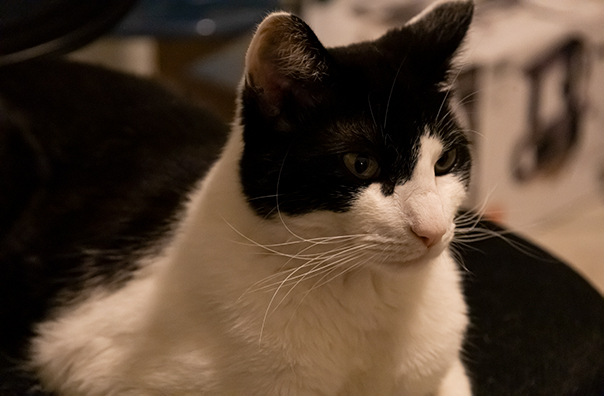
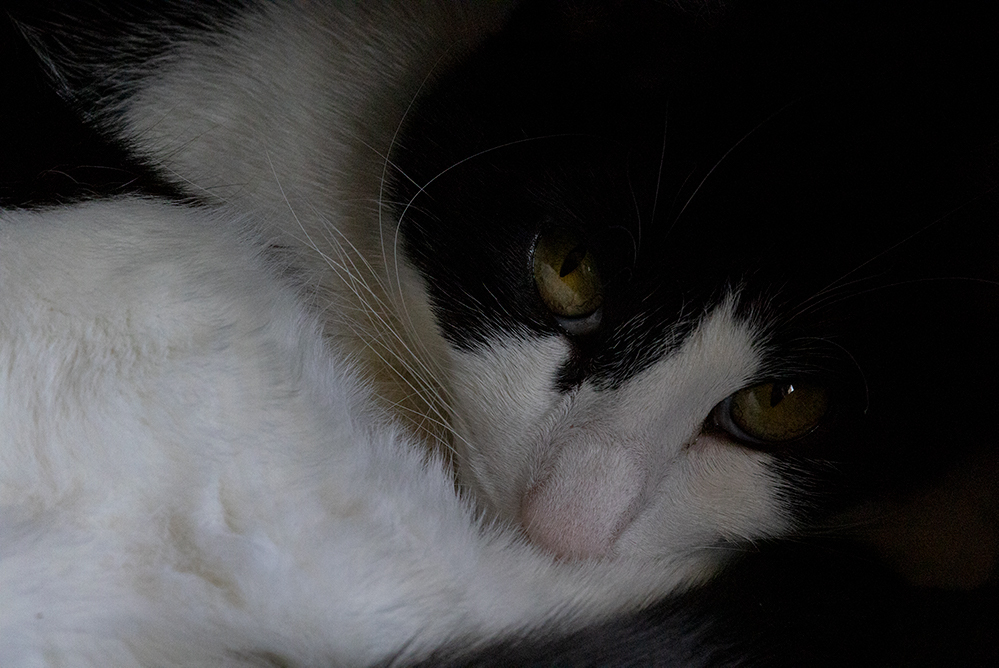
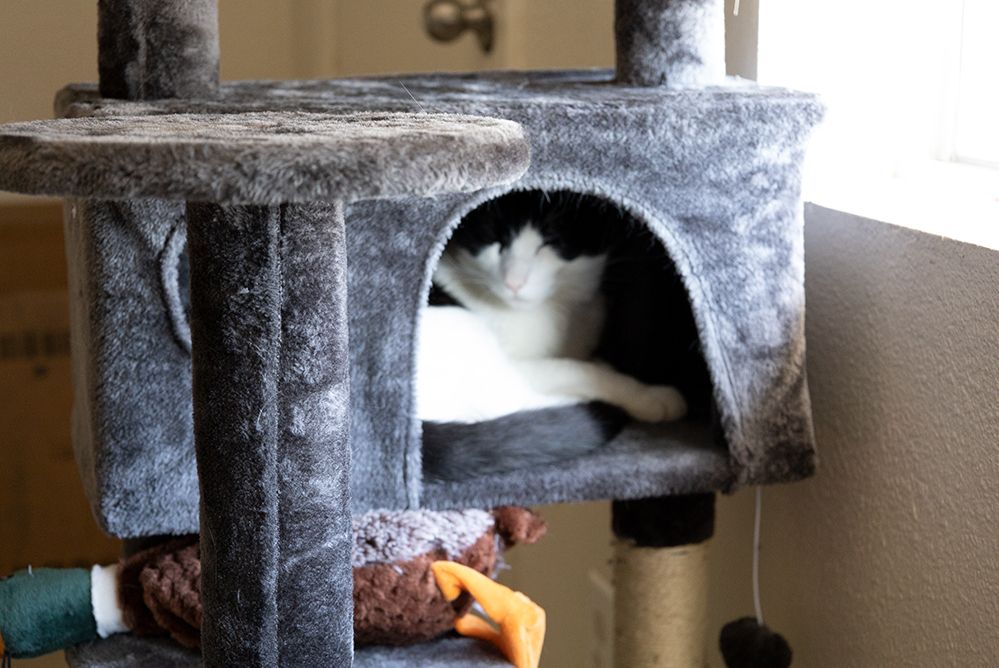
To the right is the first picture I took of my cat. It’s been a tradition with new cameras. She’s getting a little more comfortable in front of the lens. Even though the look on her face is “Great pictures…ugh”
I am very happy with the results so far. I was surprised to see this was taken at f/7.1 1/20th Sec. at an ISO 12800. I wasn’t even trying to hold the camera steady.
f/8 1/601th Sec. ISO 40000
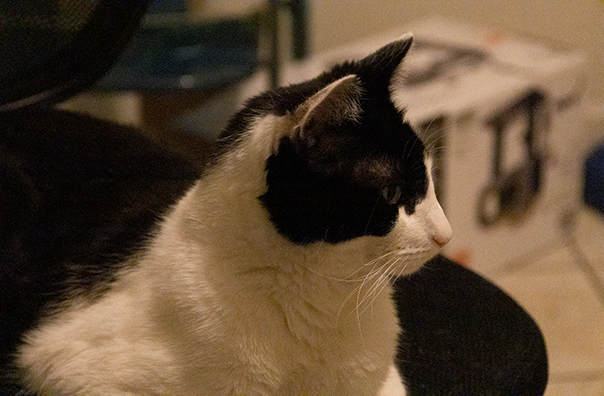
The second picture I attempted manual settings at f/8 1/60th Sec. ISO 40000. The image at full size is pretty noisy, but I think this still came out with good results.
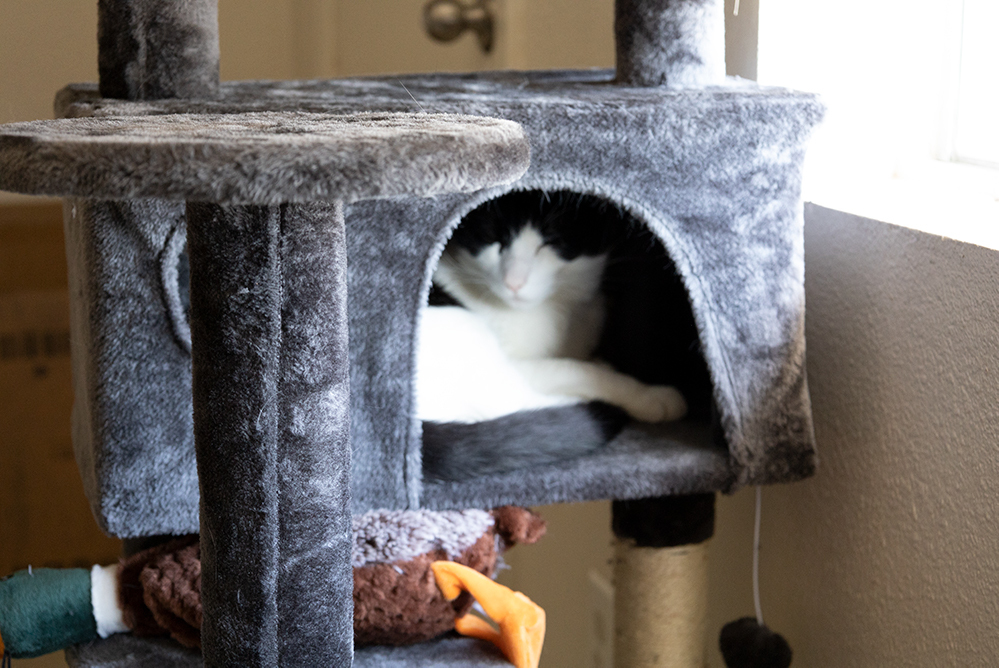
I could use photoshop to soften the noise, but it also reduces the texture in her fur. This is the sixth picture and now she’s trying to ignore what’s going on.
I was pretty tired by the time the battery charged, so I decided to get some rest and hit the road this morning. I figured just hiking with the setting on Auto would be fine. One of the things photographers struggle with in Arizona is the intensity of the sunlight. It’s tough to use the LCD or viewfinder to make sure the subject is in focus. I didn’t play with auto-focus other than have Eye-detection on. I think this may have added some difficulty. Also Auto Focus is locked to face detection in Auto shooting mode. Still it did produce sharp images, which I was relying on.
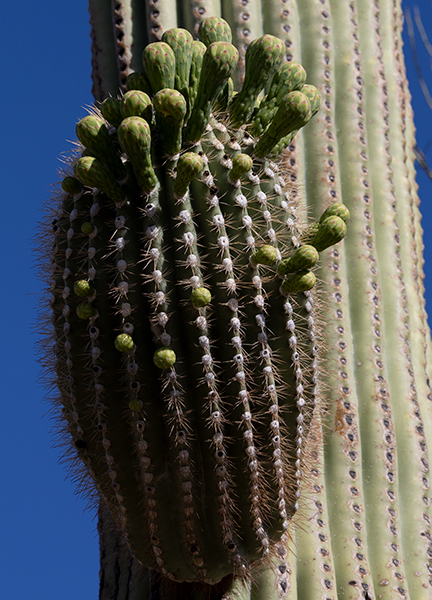
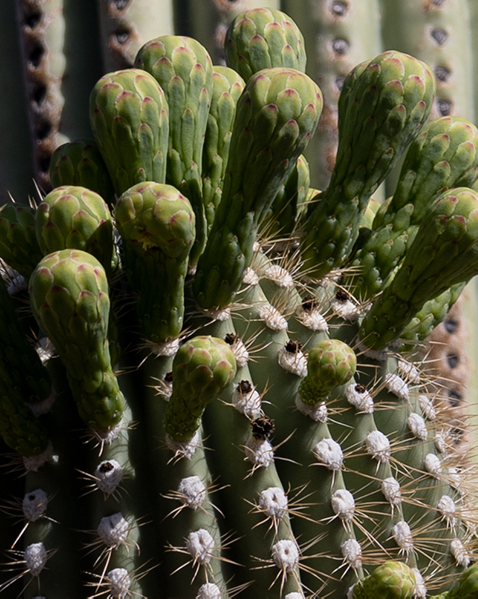
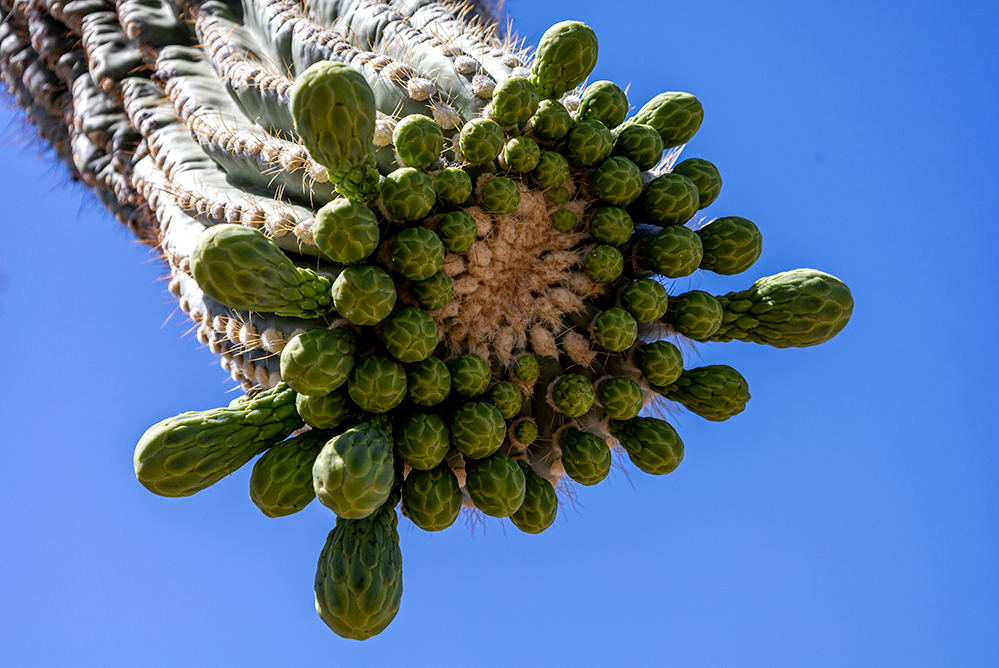
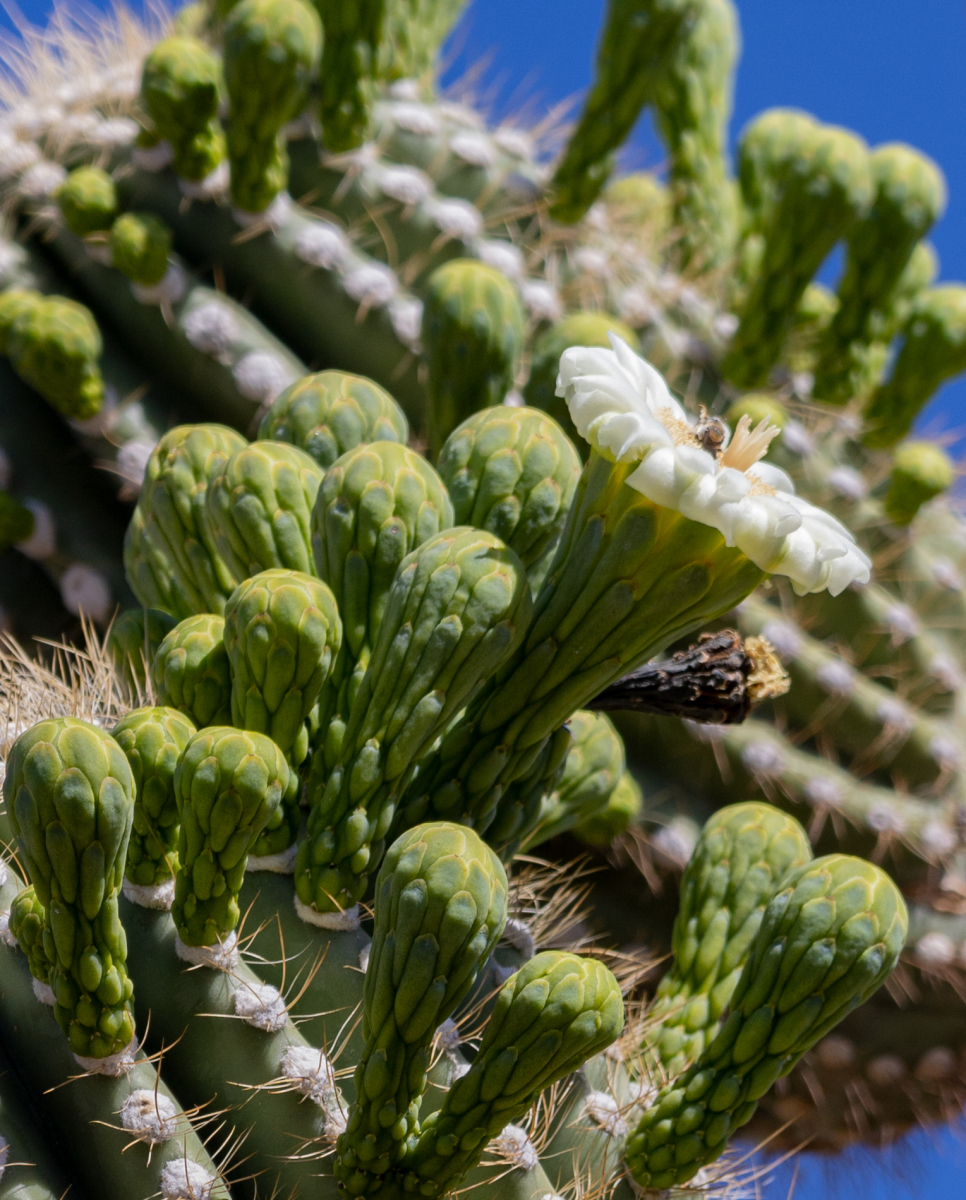
I added a cropped close up of the Saguaro fruit and needles. This was taken at 105mm at about 50ft from the Saguaro arm. (Without doing the math) Below is a closer shot on a low hanging arm with budding flowers. Kinda cool to see this perspective as most saguaros you would need a tall ladder to see what’s going on.
The conversion to jpeg reduces the quality of these dry Saguaro ribs, but this is like a macro shot at 95mm standing about 2-3 feet away. I really didn’t do this photo justice in auto mode with an aperture of f/7.1. Lesson learned!
Saguaro Ribs
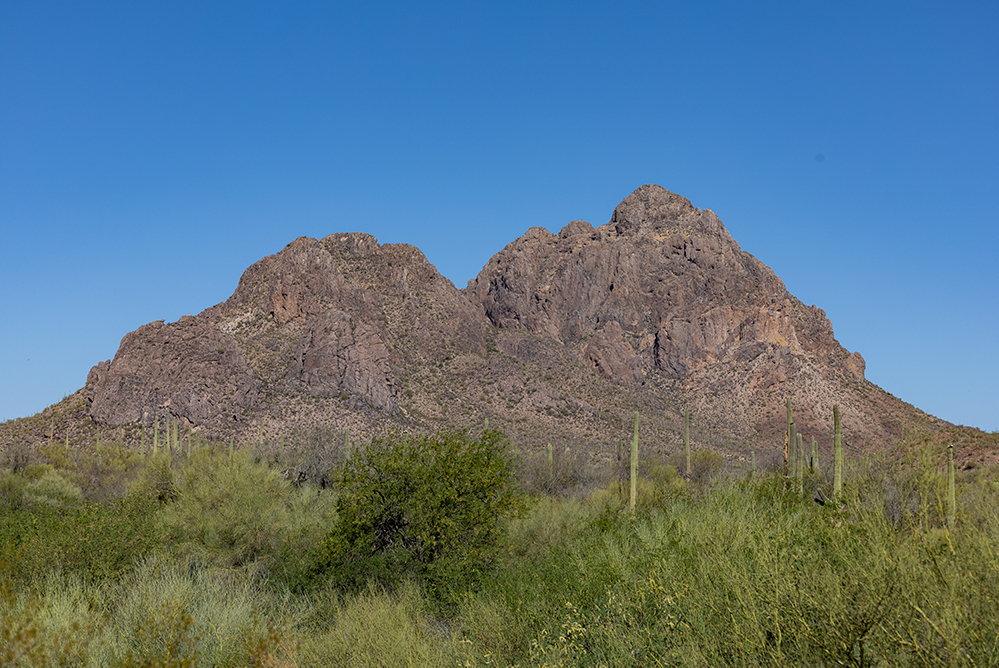
Below is a landscape image I struggled with using other cameras and lenses. In general whenever I would get home and zoom in the sky and ridgeline would have chromatic aberration, a purple line dividing the two. The green brush and trees below are crisp in comparison to past photos.
Below are a few shots where I was struggling with the focus. The depth of field bothers me a little, but still think these came out pretty good after all. I appreciate this little guy hanging around while I intruded on it’s lunch break.
I experimented with some depth of field after getting home and working on this post. I read some instructions earlier about focus bracketing and didn’t bother to look it up again. The RP has a feature that works with Canon software to bracket shots with different depths of field and combining them into one image. This is going to be a separate project for another day.
Depth of Field Play
My favorite picture so far
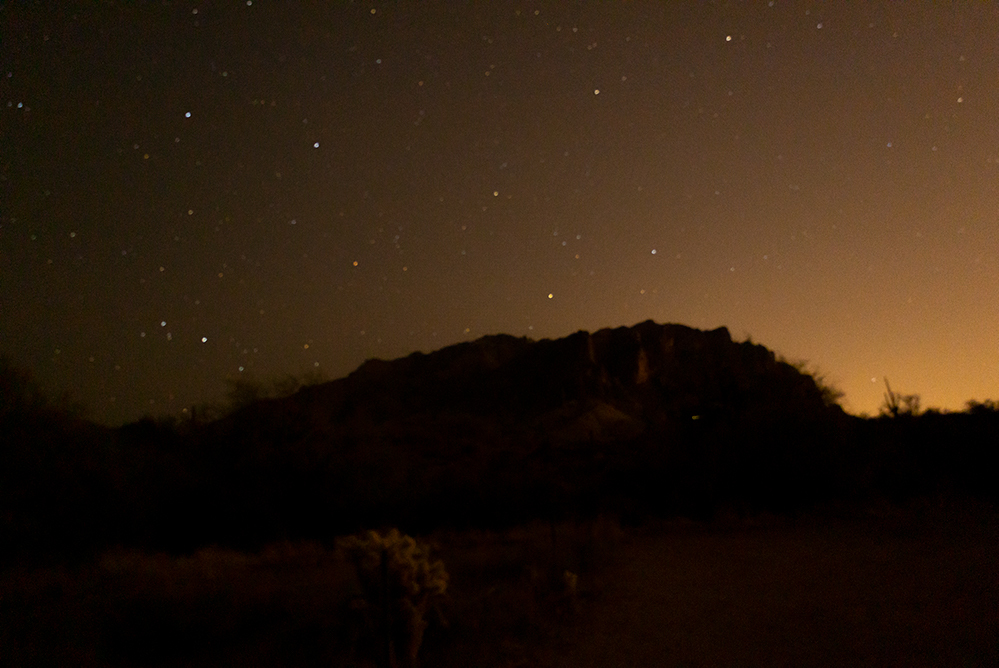
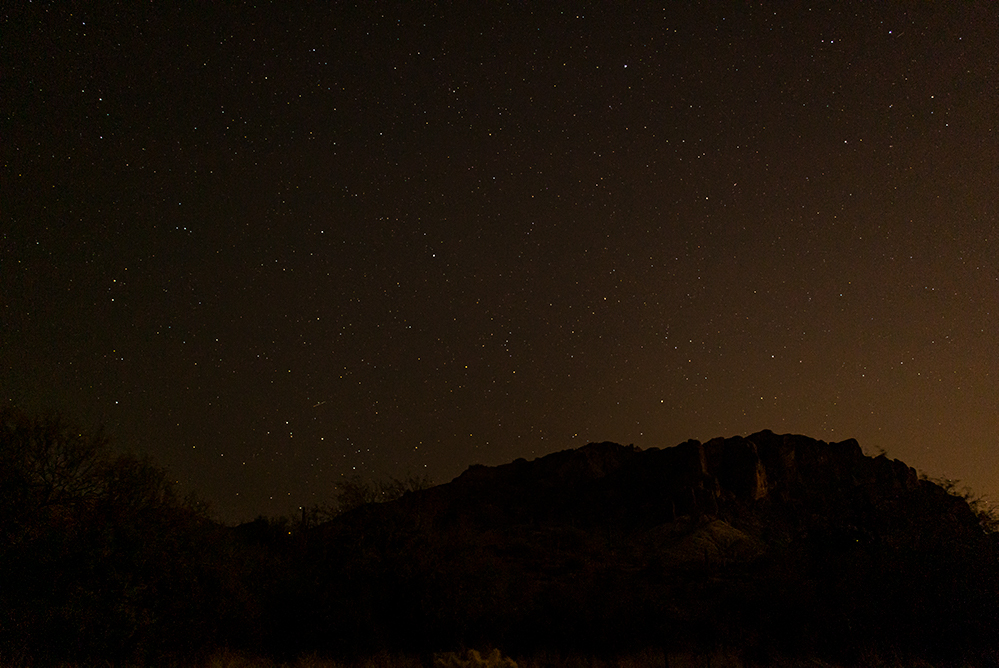
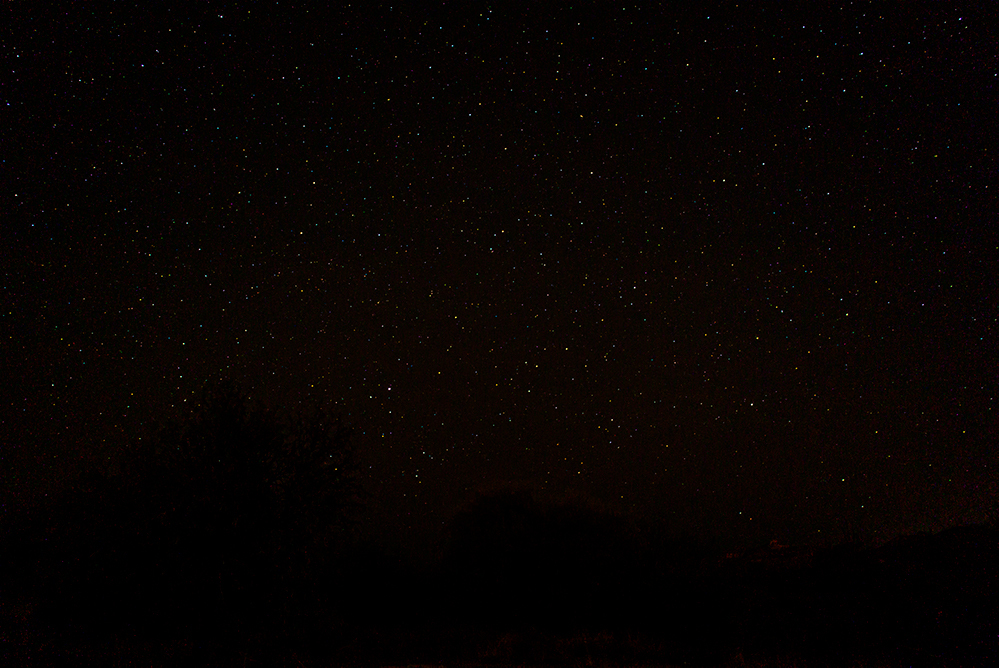
Next up was testing night photography out. Again who needs instructions?!!?1… It was fun I first started out like I did back on my old Canon T6 trying to find a bright start to focus on automatically. I didn’t realize I had left continuous focus on and that was a bit frustrating. Finally after thumbing through the menu I had the focus completely in manual. I discovered the greatest feature so far with the Canon RP, a focus meter! It still took a few shots to dial into infinity.
It’s still pretty early in the Northern Hemisphere Milky Way season, so I made sure I could get a few pictures with some stars in focus. My final settings were single shots at f/4 at 8 secs. with an ISO of 5000 at 24mm . No bracketing. Very very happy with the results and know there still some play with the settings.
Flatiron at night
200% Scale
Photo Raw adjustments to show off the universe a bit
The other day I finally consolidated back-ups and found some files that I wanted to rework. Talk about satisfaction, and a little trip down memory lane. I’m still looking through the hundreds to see what can be turned from a blurry mess into something special.
A little love of the process in Photoshop brought this photo of the Phoenix Skyline together. The goal at the time was to create a frame from flowering creosote. The intense sunlight and natural contrast proved difficult. What I saw in this was a beautiful mirage in the distance with a flowering creosote bush right in the foreground.
The aptly named Fairy Duster. This wasn’t the best shot to begin with, but with Adobe Photoshop’s Shake Reduction it recovered fairy well. 😉
These lupine are beautiful and I was a lucky guy to find them. Or did they find me?
I had a couple ask me where to find all the wildflowers before taking these. The best way is to get out of your car and walk a trail. These photos make the flower appear larger than they actually are. So to see them you have to see a hint of purple, yellow, blues among the desert brush hiding them from the road.
My favorite Lost & Found is officially this image of the Milky Way Core. The color is like being inside a kaleidoscope in the middle of the high desert mountains.
Went out for a quick hike and captured a great series of photos with Bees and Lavender the other day. I was feeling relaxed, calm, cool and calculated in a light swarm of bees feasting on brittlebrush, creosote, and of course lavender. Some of these might make a nice coffee table book if found in the annals of stock photography on Dreamstime.
I got a nice confidence boost from my local bee lovers in the AZ Photography group and feel these are sweet enough to attract more than a few people. Which makes me think of how specific animals have a niche market. Bees, Ladybugs, birds, fish, etc. It means I need to add a better telephoto lens that meets 2020 image standards.
Still figuring out the keywording for most stock websites as I help catalog plant species in the Sonoran Desert. It’s such a specific market most of what I am taking is just waiting for a few people rather than many. Time will tell if this was a personal epiphany. In the meantime feel free to use the cover photo for non-commercial use. If you have an idea for profit let me in on it.
I like how my delivery work can turn into a day trip for photos. It’s not something I could do in an office job where they expect you to be at your desk looking busy all day.
Last Thursday I had a quick delivery to the outskirts of Phoenix and decided to see if I could get paid to go back with a trip. Otherwise that afternoon traffic in construction going East on the 101 was a no-go. I received a round trip with a group of young transplants from Chicago and they mentioned Sedona at some point.
Hmmm I was a third of the way there already. Hell why not? Right about the turn off point to Sedona my gut told me to pull off and check the map. I pull into a gas station to review Google maps as the afternoon sun was about to drop quick, it didn’t leave room for much exploration.
For some reason Arcosanti popped into my head and I Googled it. What? It’s where? No lie, I look up and was staring at the road sign pointing to Arcosanti. My observation skills were on point.
It’s a long bumpy road past some other local business or ranches. At the end is a small dirt parking lot and a paved path to the entrance. Met this orange tabby along the way.
Arcology = Architecture and Ecology
Paolo Soleri is the visionary behind Arcosanti. If you are not familiar with either check out the website it’s an entire college course once you enter the rabbit hole.
Arcosanti showcases the principals of Arcology or Architecture and Ecology. If you look back at the cover image there is a stair encasement to the right that leads to the visitor areas.
Taliesin West is where Paolo studied for a while after earning his doctorate in Italy. The use of land and architecture goes back to ancient history most of my observations are Arcosanti uses Roman and Egyptian technology for heating, cooling, and lighting.
The basic thought is we are wasting space, wasting time, wasting resources, causing pollution, and most importantly removing ourselves from nature one street at a time. An Arcologically developed city would condense populations to make use of resources more efficiently. Think of science/fiction space exploration movies with an entire city housed in one ship.
Once I made it to the third floor visitor center I took a look around and held off on more photos. Eventually I was greeted by someone and paid for the $15 tour. Depending on the time you can buy lunch and even stay the night. I was told photos were ok (free advertising) and to have a seat where this Wind Bell was on display next to the tour video playing.
As the video ended we got the spiel from our tour guide. Our tour group consisted of me and another dude, so easy day for her.
Our first stop was the ceramic workshop/amphitheater. This time of year is gorgeous for working outdoors in the shade with a light breeze. Come summer I would be interested in seeing the temps and probably will for a chance to get better night shots.
I’ll be honest my listening became selective at this point as I was there to take pictures and my camera needed attention. Our tour guide probably was glad we didn’t have a ton of questions too.
Checkout the gallery below for some of the shots on the guided tour.
Visitors Trail
There’s also a non-guided tour persay, but it won’t get you inside very far. Although a great place for a panoramic shot of Arcosanti. At the bottom of the stair encasement is the door to the Visitors Trail. The end of the trail is marked with a kite shaped awning on a single pole, which is on the other side of the valley. It’s maybe a mile long in total, down the valley, up the other side and back. A little slippery in spots, but not incredibly challenging. I did it in my driving shoes.
Future Plans
I’m going to look into the overnight stay a little more. I left wanting to spend more time making the right adjustments, catching the right light, the right angle, setting up HDR shots.
Along the way home I decided to stop and visit Bloody Basin – Agua Fria National Monument for my sunset shot. Ended up being more interested in making this composite of the Orion constellation. The brightest star, Betelgeuse, is spinning off plasma as it moves through the universe. Turns out what I was observing was dust.
Well anyways thanks for reading, go check Arcosanti out for yourself. Certainly worth a quick stop on your way north.